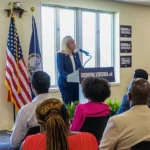
Governor Spanberger sent an unprecedented number of amendments on 180 bills back to the General Assembly and while many were accepted, more than a dozen were rejected or passed by highlighting tensions between the Governor and lawmakers. In addition, Legislators failed to pass a budget, proving that governing is hard even when a party holds a trifecta with the House of Delegates, State Senate, and Governor’s office.
Tension between Legislators and Governor Spanberger over amendments
During the 2026 legislative session, Virginia Governor Abigail Spanberger sent amendments to 180 bills back to the General Assembly and vetoed 8 bills. The amendments, which represented significant rewrites on issues including marijuana, gun control, and energy policy, faced tough criticism from the Democratic-controlled legislature. The House of Delegates and state Senate did accept most of Spanberger’s recommendations, but declined to vote on suggestions to major pieces of legislation. The rejected amendments confirm open disagreement in the Democratic trifecta after nearly two weeks of reported tension between the General Assembly and governor’s office.
Lawmakers said that the governor’s amendments present a significant departure from the intention of the bills as they were passed by the legislative body.
Governor Spanberger now faces a tough choice: whether or not to veto marquee Democratic legislation after the General Assembly did not accept her changes.
Key amendments that were rejected or “passed-by”:
- Collective Bargaining: Lawmakers rejected amendments that would repeal the existing prohibition on collective bargaining by public employees and delayed the implementation for local government employees until 2030.
- Energy and Data Centers: Lawmakers accepted amendments to bills that reallocated distribution costs for data centers to rein in residential power bills, but rejected amendments that would have lowered the return on equity for Dominion Energy.
- Cannabis Sales and Sentence modification Process: Lawmakers rejected amendments to bills that would have delayed the start of retail sales for marijuana and also an amendment that would have replaced an automatic hearing for sentence modification for those convicted of cannabis crimes before decriminalization with a petition-based system.
- Prescription Drug Affordability: Lawmakers rejected an amendment to bills that would have turned a prescription drug affordability board into an advisory body.
- Paid Leave: Lawmakers rejected amendments to a bill on paid leave that would have more narrowly defined who qualifies as a family member that employees could use sick leave to care for.
- Automatic Weapons Ban: Lawmakers rejected changes to the controversial assault weapons ban. One would have removed the word “fixed,” and another would have changed how the bill would have affected certain hunting rifles.
- ICE Enforcement: Legislators accepted an amendment to a bill that requires law enforcement agencies and U.S. Immigration and Customs Enforcement to agree to certain parameters in order to enter into formal agreements. The agreements, known as 287(g) agreements, deputize local law enforcement officers to act as immigration enforcement agents. Legislators rejected amendments to two additional ICE-related bills, one that prevents law enforcement agents from covering their faces with exceptions for health and safety reasons like protecting from toxic substances, and one that prevents immigration arrests at courthouses and other protected spaces without a valid judicial warrant.
The legislature also took the extraordinary step of preemptively overriding a potential veto of a bill, after rejecting amendments that Spanberger proposed on conservation easements.
Failure of the General Assembly to pass a budget
The Virginia General Assembly has failed to pass a biennial budget (July 1, 2026 – June 30, 2028) due to stalled negotiations over data center tax exemptions. Despite a special session on 4/23/26, lawmakers adjourned without a deal, causing uncertainty for local governments and school funding.
Key Details of the 2026 Budget Impasse:
- Sticking Point: The House of Delegates and the Senate are divided over a proposal to end a billions-dollar sales tax exemption for data center equipment and software.
- Impact: While a “caboose” budget covering funding until June 30, 2026, was passed and signed by Governor Abigail Spanberger, the lack of a new budget threatens.
- Disagreement Scope: The conflict highlights tensions over tax policy and economic incentives, with the House favoring the current incentives and the Senate aiming to end them to increase revenue.
This stalemate marks the eleventh time since the year 2000 that the Virginia legislature has failed to pass a budget by the adjournment of the regular session.
Learn More
- General Assembly declines Spanberger amendments to major legislation
- First in the South: Virginia Enacts Paid Family & Medical Leave | VEC
- Virginia Dems reject Spanberger’s changes on collective bargaining bill – Dogwood
- General Assembly rejects Virginia Gov. Spanberger’s amendments to key policy initiatives
- General Assembly rejects more than a dozen of Spanberger’s amendments
- General Assembly gavels in for special session despite no budget deal
- General Assembly to leave Richmond without budget, negotiators say they’re working on it