“Today is going to be my peaceful day.”
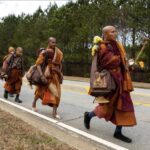
This refrain will sound familiar to anyone following the Walk for Peace, the 120-day, 2,300-mile journey from Fort Worth, Texas, to Washington, D.C., undertaken by a group of Buddhist monks to raise awareness of inner peace and mindfulness.
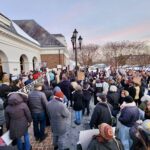
I encountered the monks on three different days as they traveled through central Virginia. The first time, my youngest child and I saw them briefly as they approached their midday rest stop in Chester. We arrived just as they came into view, and to my surprise, I became overwhelmed and began to cry. The next day, the 100th day of their journey, I saw them again as they passed through Richmond. While etiquette usually calls for quiet, respectful observation from the roadside, this time we were invited to walk behind them from a fire station south of the river to City Hall north of it. There thousands gathered for a peace rally, including our newly elected governor. Wanting to be mindfully in community, I joined the walk and listened to the wisdom they shared.
Two days later, I hoped to see the monks again in Caroline County, this time away from the crowds along a quiet rural stretch. My timing was off, and I found myself nearly a mile behind them as they approached their stopping point for the night. Still, I rerouted and arrived in time to witness their collective arrival.
Since then, I’ve reflected on their journey and my own response to it, especially the tears that surprised me that first day. I was drawn to the monks partly by the sheer scale of their effort. In a world marked by chaos and cruelty, I was also longing for a reminder of the power of community, mindfulness, and peace. Because the practice of mindfulness is powerful.
During a period of deep personal distress, I enrolled in an online Mindfulness-Based Stress Reduction (MBSR) course. One of my classmates was a Buddhist monk living in a monastic community not unlike the one now crossing the country. Developed by Dr. Jon Kabat-Zinn in 1979, MBSR is an evidence-based, eight-week program that uses meditation and mindful movement to cultivate nonjudgmental awareness of the present moment. One memory from that time stands out vividly. Our class met on the night of the Uvalde school shooting when 21 people, mostly children, were killed. Instead of discussing the assigned reading when we broke into our small groups, mine sat together in intentional silence, grieving collectively. It was a sacred moment and a reminder that we need one another.
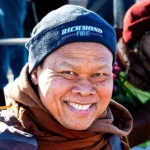
MBSR does not deny pain, whether physical, emotional, or mental; it anchors us in the present so we can meet suffering with clarity. Likewise, the Walk for Peace is not an attempt to ignore injustice, but a call to mindfulness. It is a reminder to ground our intentions and recommit ourselves to the world we wish to create. Monk Bhikkhu Pannakara, who leads the journey, has said he hopes everyone who encounters the monks carries peace back into their own lives and shares it with others. I hope that for myself and for all of us.
May we carry the peace we felt into our daily lives, sustaining us as we work for a better world. Collectively, there can be no peace without justice.
“May we—and all beings—be well, happy, and at peace.”
Take Action
- The monks will be hosting a global loving-kindness meditation on Wednesday, 2/11 from 4:30-7:30pm, we are all invited to join online at Global Meditation
Learn More
- If you would like to learn more about the MBSR course I selected, you can find upcoming classes here: MBSR Mindfulness Training: 8-Week Course in Mindfulness-Based Stress Reduction
- Check out our image gallery of the Monks walk courtesy of Zak Young