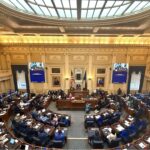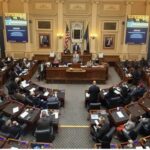
Week 2 of the 2026 Virginia General Assembly session, which ended on January 30, 2026, saw significant progress on labor rights, constitutional amendments, and the Governor’s “Affordable Virginia” agenda.
Key Legislative Developments
- Minimum Wage Increase: The House Labor and Commerce Committee advanced HB1, which aims to raise the state minimum wage to $15 per hour by 2028.
- Constitutional Amendments: Committees in both the House and Senate passed four high-priority amendments:
- Protecting abortion and contraception rights.
- Restoring voting rights for individuals with felony convictions upon completion of their sentences.
- Including same-sex marriage in the state’s constitutional language.
- Granting the General Assembly limited authority over redistricting outside the 10-year cycle (the most debated measure).
- Paid Sick Leave: Legislation (HB5) to expand mandatory paid sick leave coverage for all employees of private, state, and local government employers was also advanced.
Executive & Budget Priorities
- Affordability Agenda: Governor Abigail Spanberger continued to push her Affordable Virginia agenda, targeting rising costs in healthcare, housing, and energy.
- Energy Efficiency: HB3 was approved in committee to establish a task force coordinating weatherization programs for income-qualified households and renters.
- Budget Deliberations: Discussions began on funding for clinics and addressing the “benefits cliff” for child care subsidies.
Week 3 of the 2026 Virginia General Assembly session, which ended on Feb 6, 2026, saw infighting and challenges to redistricting, constitutional amendments, and the Governor’s “Affordable Virginia” agenda.
Key Legislative Developments
- Redistricting Dispute: Intense debate continues over a proposed constitutional amendment (HJ4) that would allow the General Assembly to redraw congressional districts in a mid-decade, non-standard cycle. Democratic leaders have published a proposed map designed to pick up four seats in the mid-term Congressional elections. Republicans have challenged and a court in Tazewell, VA has declared the redistricting unconstitutional due to procedural issues. The case will advance directly to the Supreme Court of VA for a decision.
- Affordability & Labor: The legislature is advancing proposals from the Spanberger transition team aimed at reducing living costs, including building more energy storage to lower electric bills, housing assistance, and potential minimum wage increases.
- Environmental Policy: Lawmakers are tackling PFAS (“forever chemicals”) contamination with proposed requirements for testing biosolids used as fertilizer (SB138).
- Agriculture & Energy: House Bill 512 and Senate Bill 719, creating the “Virginia Farm and Forest Prosperity Plan,” are moving forward to support the new agricultural secretariat. Legislation regarding data center energy usage (HB155) is also under review.
- Alcohol Regulation: Legislation has been introduced to remove the current, strict limits on the amount of spirits Virginia distilleries can serve to customers.
- Firearms: Committees are hearing bills regarding local control of firearms and modifying concealed handgun permit fees.
Session Logistics explained
The General Assembly remains in its 60-day “long session” for 2026. You can track specific bill progress and committee schedules through the Virginia Legislative Information System (LIS).
In the Virginia General Assembly, “crossover” is the critical mid-session deadline—occurring on February 17-18 in 2026—by which most bills must pass their originating chamber (House or Senate) to remain alive. It acts as a filtering mechanism, signaling the halfway point where only legislation approved by the opposite chamber is considered.
Usage Examples & Context
Workload Reduction: It significantly narrows the list of bills, allowing legislators to focus on the remaining, often higher-stakes, legislation.
Deadline for Survival: Bills not passing their house of origin by this date are generally considered “dead.”
Chamber Focus: Post-crossover, the House of Delegates only votes on Senate-passed bills, and the Senate only considers House-passed legislation.
Budget Alignment: Crossover week is when both chambers reveal their amendments to the Governor’s introduced budget.
Take Action
- With Crossover rapidly approaching, it’s time to make sure your legislators have your feedback on any bills they are considering.
Learn More
- Read our overview of Week 1